Core Principles
1. Lowering the Melting Point: After pre alloying aluminum with high melting point alloying elements, the overall melting point drops significantly. This makes it easier for the elements to melt and dissolve into the titanium melt within the titanium alloy’s melting temperature range, thereby preventing defects caused by unmelted elemental particles or residual inclusions;
2. Reducing the Density Difference: Balancing the density difference between the alloying elements and the molten titanium mitigates segregation issues caused by buoyancy and sinking;
3. Oxidation Protection: The aluminum matrix forms a protective film preferentially during the smelting process, reducing high-temperature oxidation and loss of valuable alloying elements;
4. Simplified Batching: Pre formulating multiple elements into a single alloy blend reduces the number of batching components, minimizes the risk of manual batching errors, and facilitates integration with automated batching production lines.
Product Advantages
1. High element recovery rate: Avoids the problems associated with elemental metals—such as low melting point and susceptibility to oxid
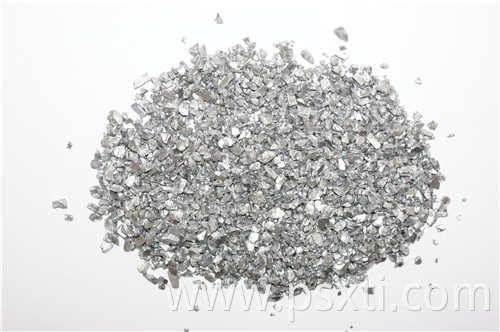
ation and burn-off—reducing material loss and saving raw material costs
2. Uniform and Stable Composition: The pre alloying process reduces compositional segregation, resulting in titanium alloys with consistent mechanical properties, making them suitable for stable mass production
3. Melting Point Optimized for Titanium Sponge: The melting point and density are closely matched to the titanium matrix, enabling rapid melting, a more favorable smelting process window, and reduced smelting difficulty
4. Comprehensive Grade System: Binary, ternary, and multi-component master alloys can all be customized to match the formulations of mainstream titanium alloy grades such as TC4, TC11, and TC18
5. Controllable Purity: Low gas content and low impurities meet the high purity requirements of aerospace, medical, and marine engineering applications
Applications: It is widely used in the smelting and alloying of various titanium alloy ingots, and also serves as a base material for the production of other aluminum based master alloy.
Intermediate alloys (also known as master alloys) for Titanium Material and titanium alloy are specialized smelting feedstock materials developed specifically to address the smelting challenges described above. They involve the pre fusion and casting of target alloying elements with matrix metals—such as aluminum and titanium—that have good compatibility, under controlled smelting conditions, to form pre alloyed materials with precise compositions and uniform microstructures. Adding master alloys during the charging stage of processes such as vacuum arc remelting (VAR), cold hearth melting, and induction melting of titanium sponge or Titanium Ingot can significantly improve the dissolution behavior of refractory alloying elements, stabilize element recovery rates, suppress compositional segregation, and ensure the consistency of composition, microstructure, and mechanical properties in the final titanium alloy products. As such, they are indispensable functional raw materials for the smelting of high end titanium alloys, and are colloquially referred to within the industry as the “industrial MSG” of titanium alloy smelting. 


 Contact Now